
Please read our Terms & Conditions before reading this article. By continuing to read this article, you acknowledge and agree to the linked Terms & Conditions provided.
It has been a few months since I wrote my last post, in fact, this is my first post for 2017! Much to my surprise (and disappointment), global share markets have rallied for the last several months since the US Election, and it seems I have missed out on significant gains due to a somewhat early exit from the markets. Both the Dow Jones Industrial Average and S&P 500 have broken record highs after record highs over the last few months, and the All Ordinaries have broken two-year highs in the local market. Hindsight is always wonderful, but the share prices just seemed a bit too high (and risky) for me right now!
The small share holdings I currently have are really just for diversification and FOMO (fear of missing out) in case the markets continue to rise. It seems the markets are feeling so good right now that even terrorist attacks around the world and geopolitical instability (such as Syrian gas attack, Russia-US tensions) have not shaken investor confidence.
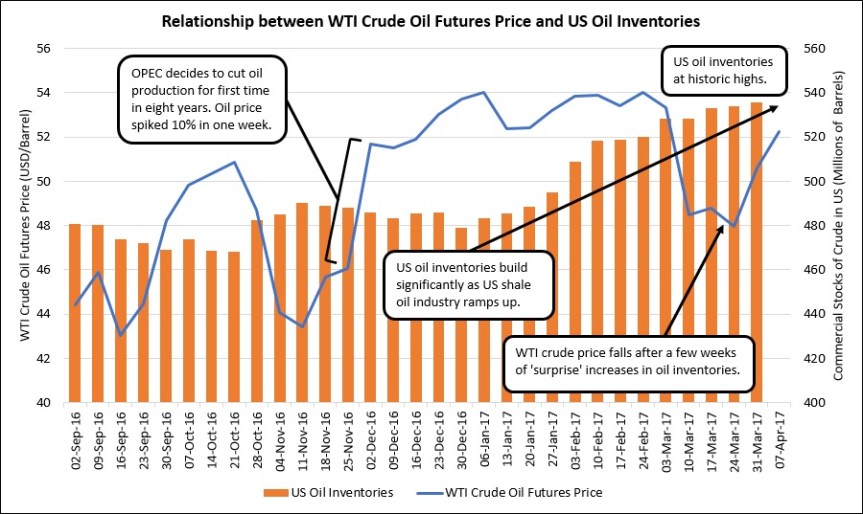
What got me particularly interested in the last couple of weeks is the relationship between oil price and the build up of oil inventories in the US. Near the end of last year, I posted about the OPEC meeting where member nations have agreed to cut oil production for the first time in eight years. At the time, the markets expected the oil inventories will be gradually drawn down with WTI Crude Oil futures prices rising back to around $50 – $60 USD a barrel in the near term.
Since then, WTI Crude Oil futures prices have stayed above $50 USD as predicted, however the strong prices have encouraged US shale producers to ramp up production, contrary to the outcome OPEC was trying to achieve. Since the OPEC meeting in November last year, US oil inventories have continued to build significantly, reaching record highs at over 535 million barrels at the end of March. The enormous stockpile has surprised the markets, putting some pressure on prices over the March period, but recent geopolitical instability in Syria and tensions between the US and Russia as well as North Korea have caused oil prices to shoot back above $52 USD a barrel. The graph at the top of this post provides a visual representation of the relationship between oil prices and US oil inventories.
Strong oil prices have also lifted the share prices of oil producers, with Woodside Petroleum [ASX:WPL] reaching 52-week high at just below $34 per share on 12 April 2017.
With the US oil inventories ballooning to record highs and increasing supply coming from US shale production, the current oil prices could come under pressure. It doesn’t seem to make sense for both inventories and prices to stay high for a prolonged period of time, especially without significant changes in demand. I am staying away from investing in the energy sector until I can see a trend of either falling inventories or falling prices.
 INVESTCOST